
The Dachshund is an intelligent little breed with an energetic and loyal personality. This small and courageous little breed can be focused and hearty and often punches above its weight. Due to its slender long body, the Dachshund can be prone to health problems, particularly spinal problems, so care should be taken when handling or jumping on and off furniture.
Physical Characteristics
The Dachshund is a small scent hound that was bred for hunting. They are also known as Sausage Dogs in UK, Ireland and Australia, whilst in Germany they are known as Dackel, or Badger Dogs which is the German translation of Dachshund.
The pronunciation of Dachshund differs depending on country.
The English pronunciation can be "dax-hund" or it can be "dash-hound" whilst the German pronunciation is "dax-hunt".
Dachshunds are bred in two sizes: the standard Dachshund, which was originally bred to hunt badgers, and the miniature Dachshund, which was bred to hunt rabbits.
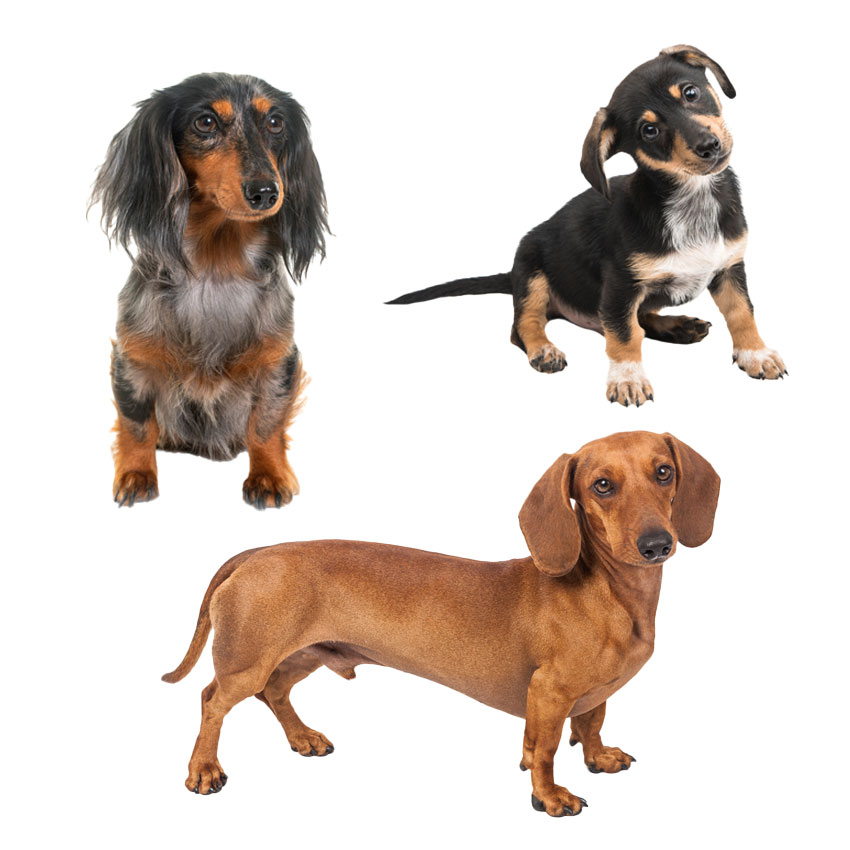
There are three coat types.
- Smooth-haired
- Wire-haired
- Long-haired
They have a variety of colours: black and tan, brown, red and dappled, which is a combination of colours and is a result of the Merle gene being inherited, like some Border Collies and Australian Shepherds. However, the breed is mostly recognised as black and tan.
They are small in stature with long bodies and short legs, which gave them the advantage of being a shape and size to follow a scent into burrows.
History
The Dachshund can be traced back to 15th century Germany. Remains of dogs resembling this breed were excavated in Roman settlements in Germany, however, dogs of a similar shape and size have also been found depicted on the walls of ancient Egyptian Temples. Sculptures of dogs resembling Dachshunds have also been found as far afield as Peru, Mexico, Greece and China.
It is believed that Dachshunds were bred from a variety of hounds and terriers, including the German Shorthaired Pointer, the Pinscher, and the Bracke.
Dachshunds have been popular pets for centuries, and they have been owned by many famous people, including Queen Victoria, Pablo Picasso, and Andy Warhol.
During the World Wars, their popularity tumbled, due to their association with Germany. In the United States they were derogatory referred to as "Liberty Dogs" to avoid association with the enemy.
They were also set to work during the World Wars. Their size and bravery made them very useful in the trenches, and they were used as messenger dogs. They were also used to sniff out landmines too.
Today, these bold little dogs are rarely used as hunters and are now companion dogs and show dogs. They consistently rank high in their popularity of dogs in the United Kingdom.
Personality & Temperament
This intelligent little dog has a, brave, lively and loyal temperament. The breed can be focused, attentive and feisty at times. For their size, they can show courage and determination in protecting themselves, especially if they are in a trusted pack.
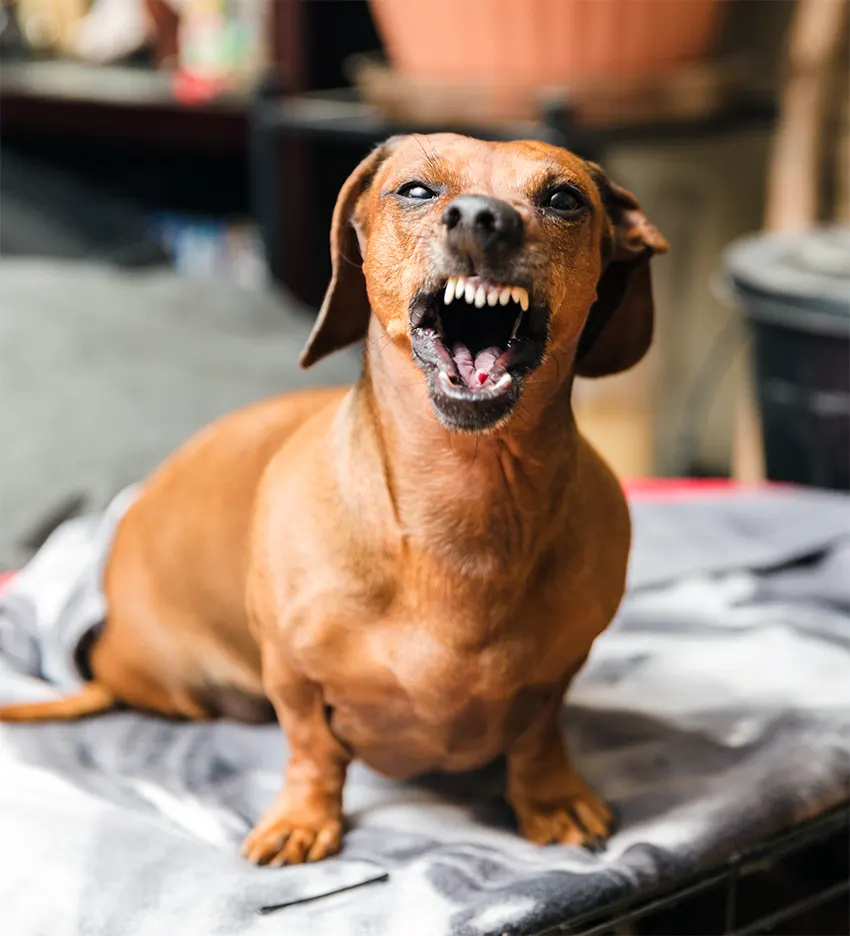
They can be stubborn, sometimes fussy, and if not well socialised with good guidance, they can be nervous, mistrusting and tentative around strangers, using their bark and body language to ward off unwanted attention.
They can be reluctant to interact with strangers until they get to know and trust them. Once you have proved yourself to be a trustworthy friend, they will be confident and happy to seek affection.
They can be reluctant to interact with strangers until they get to know and trust them. Once you have proved yourself to be a trustworthy friend, they will be confident and happy to seek affection.
They own a reputation of being fearless little warriors, which is understandable as it was no easy feat hunting badgers.
Author E.B. White wrote about the impossibility of being able to coax any degree of obedience out of his Dachshunds. He wrote, "Being the owner of dachshunds, to me a book on dog discipline becomes a volume of inspired humour… I would rather train a striped zebra to balance an Indian club than induce a dachshund to heed my slightest command... When I address Fred, I never have to raise either my voice or my hopes. He even disobeys me when I instruct him in something he wants to do."

Physical Attributes & Health Issues
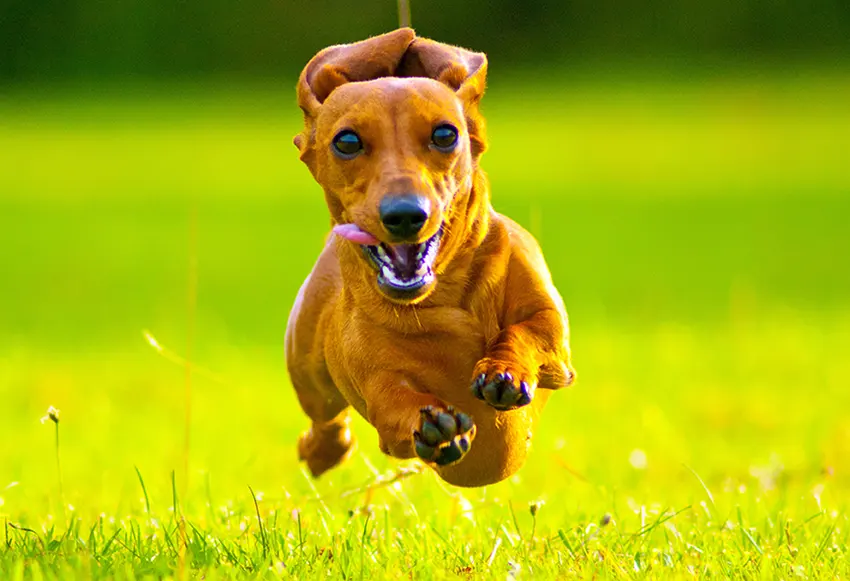
Dachshunds have excellent stamina and are physically strong dogs. Despite their long bodies, they can be fearless when jumping around onto various levels and terrain.
Due to their body length, they are prone to slipped discs in their vertebrae, so they should not be encouraged to jump up and down to their humans or onto furniture. There are many excellent aids for enabling small dogs to safely gain access to furniture and in and out of cars without needing to jump.
If they injure their back, it can result in the need for very expensive surgery and a lengthy recovery time. Keeping a lively and inquisitive Dachshund still during post operative recouperation can also be a challenge!
It is important not to overfeed as it can lead to obesity. Obesity of a small dog with a such a long body, can put extra strain on their long spine and short limbs, so it is important to maintain a healthy weight by a controlled and healthy diet. With the right amount of exercise for their size and breed and a sensible diet it is easy to maintain a sensible weight to minimise any health problems.
Nutrition
It is very important that your Dachshund does not become overweight or obese. Not only is it unhealthy for your pet, but for a Dachshund it can be fatal. If they become overweight or obese it can put extreme pressure on their spine, due to their long body. This can lead to a slipped or ruptured disc. Sometime the disc can be repaired with an operation, followed by a lengthy recovery, but unfortunately sometimes it cannot be repaired. You could then be faced with a very difficult decision to make.
Feed them an appropriate diet, provide moderate exercise, to build the back muscles, and try to avoid feeding table scraps and high fat food.
You may get that pleading look from your pet over the table but it is really important to not give in too much and to control their food intake.

Grooming

The breeds grooming needs depend on their coat type. The shorthaired coat does not need much grooming apart for the odd bath and brushing.
The wirehaired coat can be stripped a few times per year but beyond that it doesn't really need to much maintenance.
The longhaired coat may need more maintenance. It will usually need clipping a few times during the year and the ears and face will need to be kept well-trimmed and regularly brushed to maintain the quality of the coat.
Over bathing can remove the oils out of the coat so it's not advised to bath your dog too frequently.
Their nails should be inspected weekly and attended to as necessary.
Breed Traits
The Dachshund has a high prey drive and may instinctively chase small animals. Care must be taken on walks, and with off lead exercise in appropriate areas, so they don’t have the chance to chase when they pick up an enticing scent.
This breed tends to be alert and brave, and their hunting instincts can make them watchful and fearless, regardless of their small stature.
They are a very intelligent breed, but they are also very stubborn too, which can sometime be challenging. They love both giving and receiving affection and are a sensitive breed who do not react well to harsh commands. Patience and consistency are key to bringing the best out of a Dachshund.
They have an excellent sense of smell and were bred to follow trails, so if they pick up on something more interesting than you, they may not always pay attention.
Training
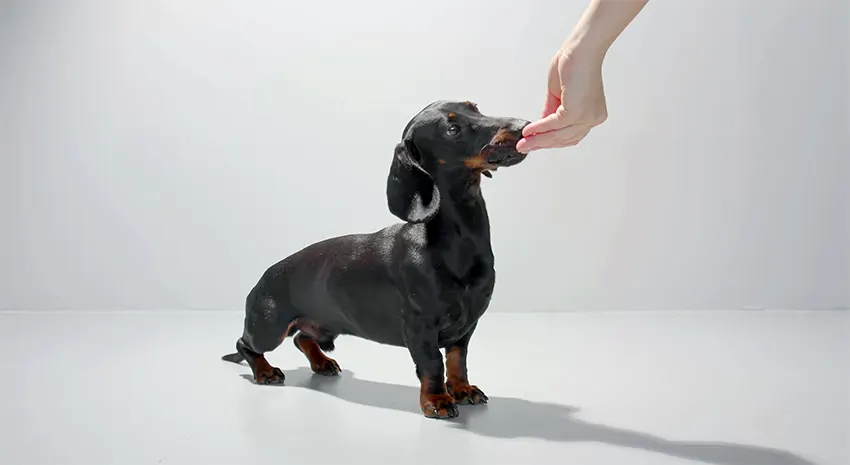
As Dachshunds are originally a working breed, they need to be given good mental stimulation and regular moderate physical exercise that is safe and appropriate for their physical attributes and size.
Dachshunds are intelligent dogs and can be trained effectively to be calm, confident, attentive and responsive to their humans, with good, consistent guidance, understanding and encouragement to repeat desired behaviours. However, consistency is vital. If their human family members don’t provide calm consistent leadership and guidance, this breed can take matters into their own paws and make decisions to protect themselves, their homes, and family members.
Dachshunds are naturally wary of new visitors to the home and won't fully trust a new visitor until they are comfortable that they are not a threat. As they are alert and protective, care must be taken not to give the Dachshund a vantage point in their home to guard at windows, where they can quickly learn to bark at passers-by and successfully, in their view, ‘chase them away’. This practice can encourage guarding and over-protective behaviour, and it can cause them to be anxious or objectional to visitors or passers-by.
It is best not to allow them on furniture as jumping up and jumping off furniture can cause impact damage to their already susceptible spine. It is also better to keep them from running up and down stairs as this puts unnecessary strain on their spine too.
Common Behaviour Problems
Without good consistent guidance, training and socialisation, this little dog can be mistrusting and have a strong pack instinct. When they feel the need to be protective, they can easily forget their small size and confidently chase off what they perceive to be a threat.
They can also lack confidence and suffer separation anxiety, if they are not shown that they are safe and that their human companion is their guardian and protector. A timid Dachshund can be reluctant to venture out on walks and be very wary of strangers. They need good, sensible boundaries and regular safe, enjoyable routines to help build their confidence, to understand that they don’t have a responsibility to protect themselves or their family and not be suspicious of anything that is unusual to them.
As Dachshunds are a small and cute dog, there is a common tendency for human companions to baby them, treating them like a lap dog and not appreciating that this dog has breed instincts and needs mental and appropriate physical enrichment for their size and shape. This type of relationship can result in the dog lacking experience of coping with the world and be less confident and not taking things in their stride too well.
Puppy Selection
There are many places to acquire a puppy where you can be sure you are getting a puppy that has had the proper breeding. Check out your local rescues and shelters because they have some amazing dogs and puppies that are desperate for a forever home.
Check out the local Breed Specific Rescues, animal welfare shelters, RSPCA and Dogs Trust, as they have many great dogs looking for homes too, who through no fault of their own, have ended up being abandoned. These organisations test their dogs for temperament and soundness.
By adopting, you will be helping a dog in need, one that wants nothing more than to be in a loving home. There are too many companion animals euthanised each year and Bark Busters encourages you to visit one first before buying a puppy from a breeder.
When you are selecting a puppy, try to avoid selecting the fearful or over-zealous puppy. If you are at a shelter, consider that the dog might just be traumatised by their surroundings. All those barking dogs cause timid dogs stress and quite often you will see a different dog if you can get the staff to bring him away to a private viewing section for you. Animal Welfare and Rescues do amazing work in trying to save dogs and match breeds to the right owners, so consider that option when looking for a new puppy.
Select the right puppy. One that suits your lifestyle.
Many of our Bark Busters’ trainers volunteer their services at local shelters and rescues to assist in rehabilitating dogs. Bark Busters have saved many thousands of dogs through our volunteer rescue programmes around the world.
If you do decide to go to a breeder, then ensure you view both parents to determine the puppy’s personality and parentage.
View all interaction between the puppies as this will tell you a lot about their personality. Look out for those assertive types if you want a dog that is going to be good family dog that is good with children.
Tips for Bringing a New Puppy Home
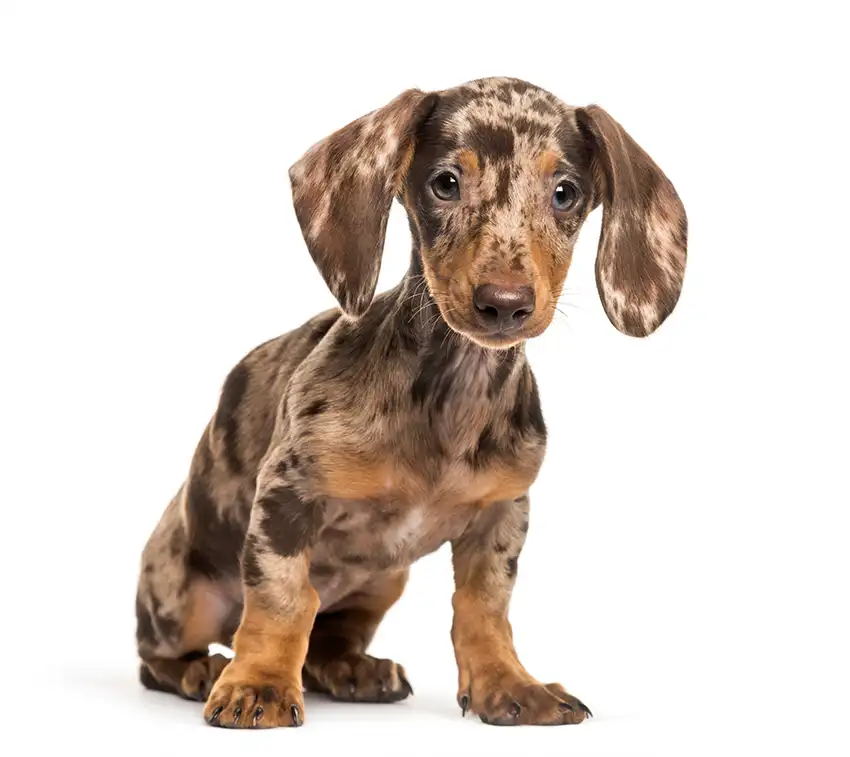
Do not bring a puppy home before it has reached 8 weeks of age but preferably 12 weeks. Any earlier and they will miss out on much needed bonding with other puppies and their mother.
Bring your puppy home early in the day to allow time for your puppy to settle into its new home.
Try to bring some bedding home with the scent of the mother dog, scent of other litter mates, or a familiar scent.
Ensure that you know where your puppy will sleep and introduce your puppy to this area during mealtimes.
If you need to leave your puppy alone for a short while, ensure that you address any barking, while hidden close by, without returning to the puppy. Returning every time your puppy demands, will only encourage more barking. Puppies do better if they know you are there nearby and have not deserted them.
Ensure you have the same diet that your puppy was being fed when with its mother. Any diet change must be a gradual one.
Ensure that you puppy proof your house and place anything dangerous out of harm's way, such as electrical cables and poisonous chemicals.
Make sure you provide lots of bathroom breaks. Take your puppy to do its business at least 8 times per day, after sleeping, eating, drinking and any exuberant exercise.
Do I Want One Dog or Two?
We are often asked by prospective dog parents if they should get one or two puppies. We always answer the same way. Get two only if you really want two dogs!
Dogs are pack animals, and they love having company, but the selection of two dogs is something that must be carefully thought through.
Two neutered males can cohabit without too many issues if their doggie parents treat them equally and do not display any favouritism. Unequal treatment is usually behind most Sibling Rivalry cases.
A male and a female of equal energy can also cohabit. This can be the best match, providing that the female and male are equally matched in size. If they are differing sizes, its best that the male is the larger of the two. Make sure that the female is neutered, when appropriate, or problems could occur if a large male tries to mate with a smaller female.
Two females are not always the perfect pair, as females invariably want to rule the household. It won’t be long before they test each other, and some females won't back down. When you have two females in a household, they both might try to be the boss of each other, which can lead to fights.
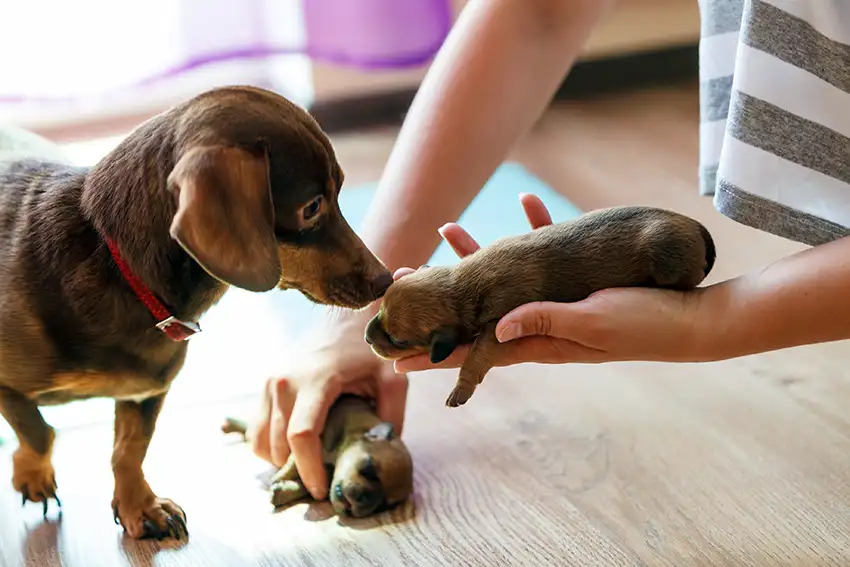
Toilet Training
Without a doubt, toilet training a puppy has its challenges and can try your patience. You need to be observant and begin as soon as the puppy is home with you. Bark Busters will make sure the process is not stressful for you or your puppy.
When puppies are first born, they relieve themselves in their den, but their mother is there to clean them. Therefore, there is no scent of urine or faeces where the puppies eat, sleep and play. As they get slightly older, they learn to imitate the mother when she goes outside. This way the puppy becomes conditioned to never eliminate in their dens. If you are crate training, you will find that puppies will avoid toileting in their crate at all costs.
Knowing when your puppy is likely to relieve themselves by reading their body language is the key to success.
Have you ever taken a puppy outside for a walk only to find they relieve themselves as soon as they get back indoors? To avoid this, walk the puppy directly to the area you have designated the toileting area. Stand still and stay with the puppy, so they no longer show interest in you. Do not sit down as this will only encourage the puppy to jump on you and forget what they are there for. Praise when they perform. NEVER scold or rub their nose in any mistakes. This is cruel and will teach your puppy to move out of sight or wait until you are not watching.
Your puppy does not possess human logic but will begin to form good habits through structured routines. Positive reinforcement when they do the right thing in the right place is the best and quickest toilet training method.
Four Basic Needs

Let's examine those four basic needs and why your dog needs them to keep it healthy, balanced and content.
Food - diet / nutrition
We promote a diet that is grain free, low in carbohydrates and without any harmful e-numbers, colours and preservatives. Carbohydrates do add energy that the dog needs to burn off and can make an already hyperactive dog more active.
The right diet, grain free and filled with fruits, vegetables and raw meat will have advantages to how your dog will feel, look and act.
If you want to understand why grains can make a dog more energetic, you only need to think of racehorses and how their trainers give them grain to get highly energetic racehorses. Energy in, equals energy out.
Bark Busters dog trainers are not vets or dietitians, so we urge you to do your own research into the best diet for your dog. A diet that you will be comfortable with.
We do however have vast experience of how highly concentrated grain diets effect behaviour and can cause hyperactivity. This is very prominent in Japan, where most dogs are fed high levels of rice in their diet which can adversely affect concentration and focus.
Safety - through leadership and education
All dogs need strong leadership and to know where they fit into the family unit. If they know they have a leader that will make all the decisions, one who is fair and just, they will be happy and content.
On the other hand, if they have no structure in their life, they have inconsistency, and don’t know how things will be from one day to the next, then they will become stressed and may experience health ailments, skin and stomach issues and behaviour problems. Routine and respect must be established. With equal doses of love and structure your dog will feel safe and secure.
Shelter - a place to call their own
Dogs love nothing better than to curl up on the couch or in a place they can call their own, even when there is more than one dog. Most dogs are very sociable, and they will think nothing of all snuggling in together. Provide your dog with its own "den", a place where they can call home, and somewhere they can go to for a bit of peace and quiet. Just make sure their "den" is warm, easy to clean and maintain.
Entertainment - toys & games
A very important part of your dog's four basic needs is their need to have something to do. If we want to avoid our pets becoming bored and destructive, then they need a way to fill their day.
Dogs thrive with physical and mental exercise. Dogs are highly intelligent animals, and they need to keep their brains active as much as their bodies. Entertainment is an important part of their well-being and essential to your dog's overall mental health.
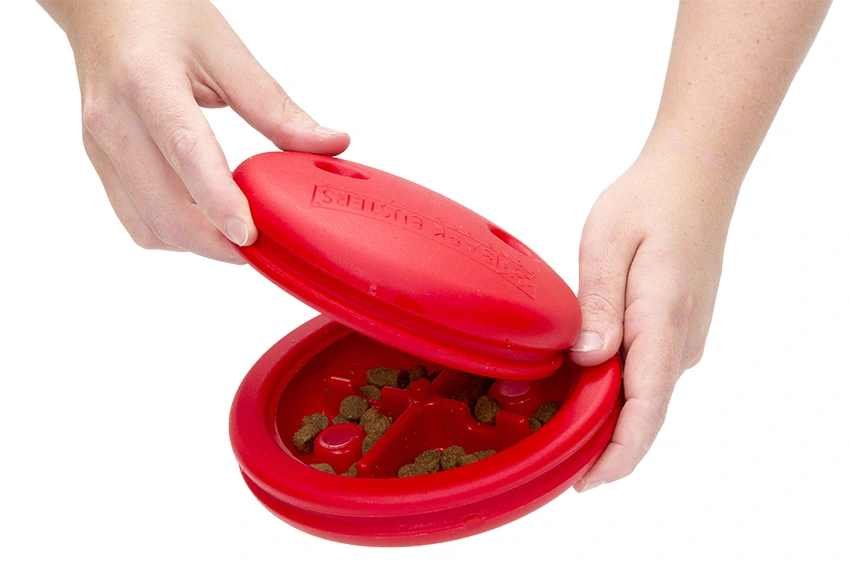
One great toy is the Bark Busters GameChanger® which helps to prevent boredom, stress, and separation anxiety. By filling it with small treats, your dog will have plenty of fun trying to get the treats to dispense.
Games to Play
We need be mindful of the games we choose to play with our dogs as we are dealing with canines who can be easily influenced by what we are teaching them to do. For example, a game where you chase your dog is not a good game to play as this only encourages your dog to grab something and run, like your shoe, a precious item, or something breakable.
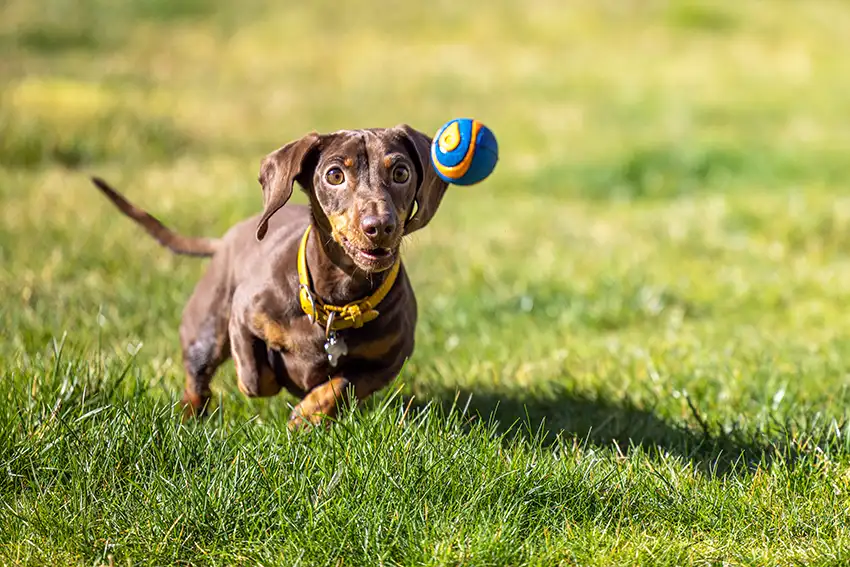
'Tug of War' is okay and playing ball is good, provided your dog is not the type that gets fixated on the ball and refuses to stop playing when requested. Hide and seek is a great game too. These are games where you hide things from your dog, such as food, toys or a ball and then encourage them to go find it. You can increase the degree of difficulty as your dog gets better at the game.
Hide and seek is a game best played where you have another family member or friend to help you. Start out where your dog sees you hide the toy, then repeat over and over, 'Find' or ‘Seek’. When your dog master this you can then move on to not letting your dog see where you have hidden the item.
Remember to give your dog praise when he finds it. These sorts of games are great entertainment and offer mind exercises for your dog that will tire them as quick as a walk. They are far better than the type of games that encourage your dog to become overexcited or possessive of its toys.
Child's Play
Dachshunds are usually good with kids, but don't allow the children to turn them into babies or little fur children, as they can become frustrated quite easily and will want to avoid the children.
We don't recommend letting the children pick the dog up as it could get hurt.
Never leave any dog alone with children regardless of the breed, size or personality.
Interactive Play
Bark Busters has the ultimate toy for all dogs that provides dogs with several options. The GameChanger® by Bark Busters is an interactive puzzle toy that delivers a treat. It's a chew toy, that they can carry around and take to their bed. They can't rip it apart like many other toys. It's a workout toy, that they flip over with their nose and scratch it with their paws. The GameChanger® comes in four vibrant colours and will give your dog lots of fun and mental stimulation.
Socialisation
As Dachshunds are comfortable being in a family pack, they can be socialised easily. This should start when they are young, ideally before they experience any negative interactions that may shape their perceptions of the world. Socialisation should be rehearsed in a safe environment with good supervision and positive encouragement and praise when they calmly accept the presence of other dogs, humans and other animals in a relaxed and friendly way. They should not be overwhelmed during initial socialisation training and should not be forced to interact with a large group of off-lead dogs at the same time, as this may be too overwhelming.
Dog Parks
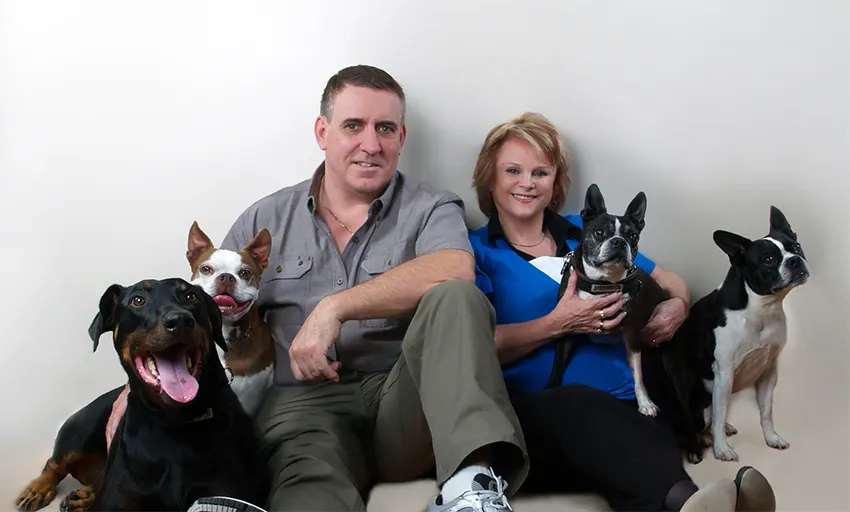
Danny and Sylvia Wilson, Founders of Bark Busters
Taking Your Dachshund to Dog Parks
Dog Parks are one of the most misunderstood dog activities of the modern-day dog world. Some doggie parents love nothing more than to take their dog to a dog park. They have been told they need to socialise their dog and so off they go.
They love the fact that their dog has fun, they get to meet other dog lovers and watch the dog's romp around and play.
That is the upside, but the downside is there are those dog lovers whose dogs don't fit into this world at all. They are those dogs or puppies that were bullied, frightened on their first visit or whose personality does not fit the mould.
These folks agonise over the fact that their dog or puppy does not look forward to its trip there, it hides under the seat of the car, or it has to be carried or enticed into the park.
Many ask us why their dog acts like this and how they can fix it?
Bark Busters do have ways to assist these pet parents, but we do also explain why their dog might not like the dog park because of its personality.
It reminds us of a friend of ours who visited us regularly with her little dog, 'Harry'.
When they would arrive, Harry would walk up to each of us, sniff our legs and walk away.
She questioned us one day on why we never petted Harry when he came up to us.
We explained that this was not what Harry was doing, he was sniffing us, not requesting a pat. If he had been requesting to be petted, after sniffing us, he would have gestured to us to pet him. He did not do that, instead he walked away.
We told her that Harry was not a social dog and preferred not to be touched by anyone other than her and he avoided any interaction with our dogs too. He was a 'one person' dog that did not feel comfortable around others.
It was like a light had been turned on, our friend smiled and told us that this explained a lot to her. She further explained that every time she took Harry to the dog park, that he could not wait to get back to the car when it was time to leave, that he would stand away from the other dogs, never join in the play and snap at other dogs when they came near him.
He was telling her in every way he could that he did not fit into that dog park crowd, just like some humans hate parties!
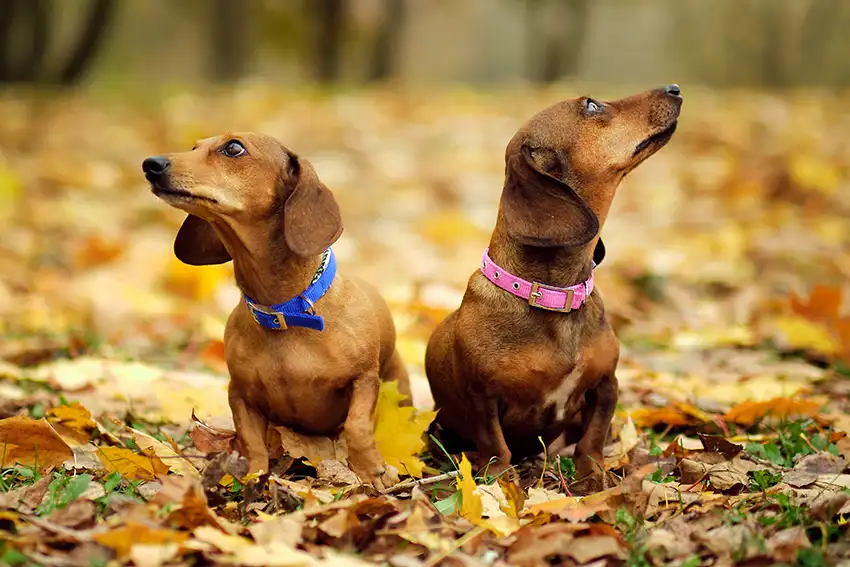
With today's dog owners having such busy lifestyles, more and more dog owners are turning to dog parks as a way of socialising and exercising their dogs. While this is great fun for most dogs and dog owners, not every dog will do well in this environment.
A breed like the Dachshund needs to be socialised with dogs of similar size and energy levels or they, or the other dogs, could become fearful, especially those larger than themselves, which could lead to 'dog aggression'.
Some high energy large breeds have little or no regard for little shy or reserved dogs and will think nothing about bowling them over and showing them who is boss of the doggie park.
If your dog doesn't enjoy this type of rough and tumble, or is traumatised by it, then you might have an issue the next time you try to visit the park.
The best way to prevent this behaviour is to see if there is an option at your dog park to match size, and possibly personality, away from the boisterous dogs. If that is not possible, try visiting the dog park in off peak hours and practice gaining focus from your dog before you allow them to run off and play.
Bark Busters Lifetime Support Guarantee
Bark Busters dog behaviour therapists and trainers have trained more than 1 Million dogs worldwide and are renowned authorities in addressing dog behaviour with all-natural, dog-friendly methods. The Bark Busters training is the only service of its kind to provide International dog training guaranteed lifetime support. With hundreds of trainers around the world, Bark Busters continues its mission to enhance the human/canine relationship and to reduce the possibility of maltreatment, abandonment and euthanasia. Contact your local Bark Busters dog trainer to see how they can help.
This article is the copyright of Bark Busters® and is intended for information purposes only. Dog owners should fully research any problems that they may have with their dogs.