
Reactive Dog Training Guildford
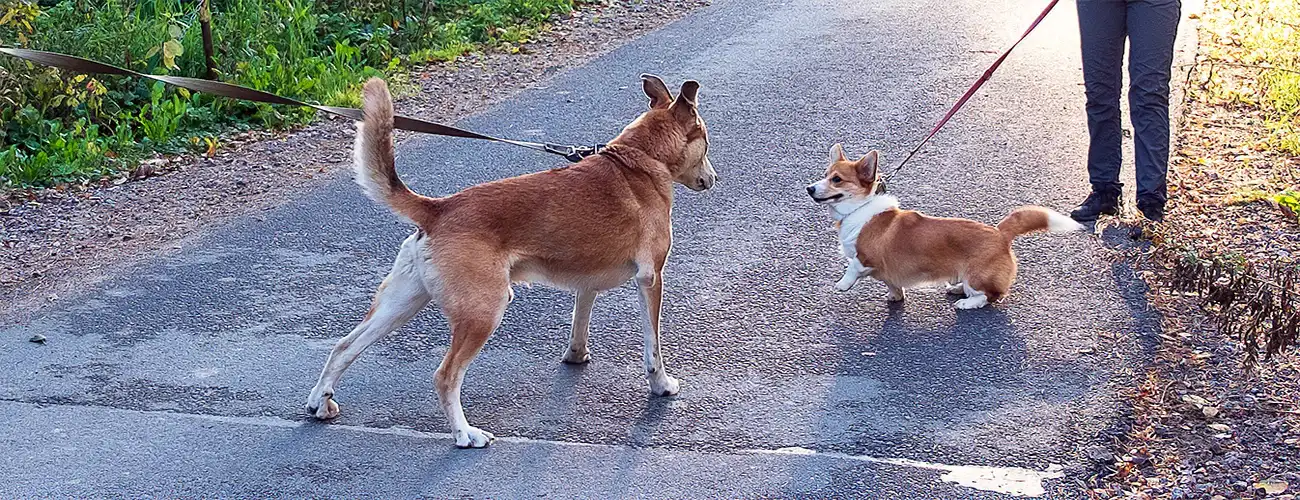
Does your dog bark, lunge, pull or become difficult to control when they see another dog, person or something else that triggers a strong reaction? Bark Busters provides personalised reactive dog training in Guildford, helping you understand your dog's behaviour and learn practical techniques to keep everyday situations calmer and more manageable.
I'm Jacquie, your local Bark Busters certified Grand Master Dog Behaviour Therapist and Trainer. I work with you and your dog in your own home and everyday environment, helping you identify what triggers your dog's reactions and develop a training programme suited to your dog, your household and the situations you encounter.
What Is a Reactive Dog?
A reactive dog responds strongly to particular triggers or situations. This can involve barking, lunging, pulling, whining, jumping, freezing or becoming so focused on the trigger that it is difficult to regain their attention.
Common triggers can include other dogs, unfamiliar people, visitors, children, cyclists and runners, cars and other vehicles, animals and wildlife, loud or sudden noises, people approaching the house, and being restrained on the lead.
Reactivity doesn't necessarily mean that your dog is aggressive.
Some dogs react because they are worried or fearful, while others may be frustrated, over-excited or unsure how to respond. Understanding what is driving the behaviour is an important part of deciding how to work with it.
Why Is My Dog Reactive?
There isn't one single cause of reactive behaviour. Previous experiences, fear, frustration, excitement, lack of confidence, the environment, and individual temperament can influence a dog's reactions.
The distance from a trigger can also make a significant difference. Your dog might watch another dog calmly from across a field but bark and lunge when that dog is only a few metres away.
That's why simply describing a dog as "reactive" doesn't tell us everything we need to know.
We look at what your dog reacts to, when the behaviour occurs, how intense the response is, and what happens immediately before and after.
If your dog's behaviour has changed suddenly, or you're concerned about pain or illness, it's also sensible to discuss the change with your vet.
Signs of Reactivity in Dogs
Reactive behaviour isn't limited to barking and lunging.
You might notice your dog staring intensely at another dog or person, becoming stiff or freezing, pulling hard towards or away from a trigger, barking repeatedly, growling, lunging, whining or vocalising, jumping or spinning on the lead, and becoming difficult to control when a trigger appears.
Learning to recognise the earlier, less obvious signs can give you an opportunity to respond before your dog becomes overwhelmed.
Home Reactive Dog Training in Guildford
Bark Busters training starts in your own home. This gives us a chance to discuss your dog's behaviour, routines, and history in a familiar environment, and to build the communication and training skills you'll need before applying them in more challenging situations.
Where appropriate, we can then look at the situations in which your dog's reactivity occurs outside the home.
Rather than deliberately putting your dog into an overwhelming situation to provoke a reaction, we'll work at a level appropriate for your dog and build skills progressively.
How Our Reactive Dog Training Works
Understand your dog's triggers - We'll identify any dogs, people, situations, or environments that tend to trigger a reaction and examine the circumstances surrounding the behaviour.
Learn to recognise early warning signs - I'll help you become more confident reading your dog's body language so you can identify when your dog is starting to feel uncomfortable, excited, or over-aroused.
Improve communication - Clear, consistent communication can help your dog understand what you want them to do. I'll show you practical techniques you can use in everyday situations.
Work at an appropriate distance - Distance can be extremely important when working with reactivity. When appropriate, training can start far enough away from a trigger for your dog to stay responsive, then gradually progress.
Practise alternative responses - Rather than simply trying to suppress barking or lunging, we'll help your dog respond more appropriately when a trigger appears.
Continue practising between lessons - You'll have a tailored training programme to practise between sessions. Consistency, communication, and repetition are important when changing established behaviour.
Reactive Dogs on Walks
Walking a reactive dog can be stressful. You may find yourself changing routes, crossing roads, walking at quieter times or constantly watching for another dog appearing around the corner.
Training can help you become more confident managing these encounters.
Depending on your dog's behaviour, we can work on loose-lead walking, maintaining your dog's attention, recognising approaching triggers early, creating appropriate distance, calmly changing direction, reducing fixation, improving your dog's response to your guidance, and managing unexpected encounters.
The goal doesn't have to be for your dog to greet every dog they see. For many dog owners, a more realistic everyday goal is to pass another dog at a comfortable distance without your dog barking, lunging, or pulling excessively, while you continue working on the issue over time.
Is My Dog Reactive or Aggressive?
Reactivity and aggression can look similar, especially when a dog barks and lunges on the lead. However, they aren't necessarily the same thing.
A reactive dog may respond because of fear, frustration, or excitement without intending to cause harm. Aggression can involve behaviours intended to increase distance or potentially result in a bite.
Some dogs can display both reactive and aggressive behaviour.
If your dog is growling, snapping, attempting to bite, or has previously bitten a person or another animal, our dog aggression training service in Guildford may also be relevant.
Understanding the behaviour, rather than relying solely on the label, helps us decide the best way to approach training.
Lead Reactivity Towards Other Dogs
One of the most common problems owners describe is a dog that behaves very differently when attached to a lead.
Your dog may bark, pull, or lunge when another dog approaches but behave differently when there is more space. Restraint can sometimes add frustration or uncertainty because your dog can't freely choose whether to approach or move away. You may have heard about the fight-or-flight instinct. When your dog is tethered to you on the lead, it removes your dog's ability to flight.
We'll look at your dog's individual behaviour and help you develop practical strategies for managing walks more effectively.
Reactivity Towards People
Dogs can also become reactive towards people. Your dog might bark at strangers, people approaching on walks, visitors, delivery drivers, runners or people behaving in unfamiliar ways.
We look at when these reactions occur and what your dog's body language tells us about how they are feeling.
When behaviour involves growling, snapping, or a risk of biting, safety and management should always come first.
Don't Wait for Your Dog to React
One of the most useful skills when living with a reactive dog is learning to act before the barking or lunging begins.
If you can recognise your dog's early signals, such as body language, and understand their triggers, you may be able to create more distance, change direction, or regain their attention while they can still respond to you.
Repeatedly letting a dog become highly reactive to a trigger can make training much harder.
Good management isn't avoiding training. It helps create better opportunities for successful training.
Why Choose Bark Busters for Reactive Dog Training in Guildford?
Reactive behaviour can be frustrating, but you need to consider it in the context of your individual dog.
With Bark Busters, training is:
Personalised - Your training programme is tailored to your dog and built around their specific behaviour and triggers.
In your everyday environment - Training starts at home and addresses the real-life situations you encounter with your dog.
Practical - I'll show you techniques that you can practise yourself between lessons.
Focused on communication - You'll learn more about your dog's body language and how to communicate more clearly with them.
Designed for real life - Our goal is to help you manage everyday situations more confidently, not just practise exercises in a training class.
Get Help With Your Reactive Dog in Guildford
Whether your dog reacts to other dogs, people, visitors, or everyday situations, I'll help you understand what's driving the behaviour and develop practical strategies to work with your dog.
Living with a reactive dog can make walks, visitors and everyday activities much harder than they need to be. Understanding what triggers your dog's reactions and learning how to respond before the behaviour escalates can make a significant difference.
Contact Bark Busters Guildford to discuss your dog's behaviour and find out more about personalised reactive dog training in Guildford.
Frequently Asked Questions on Reactivity
Can a reactive dog improve?
Many reactive dogs can make significant progress with the right training and management, though every dog is different. Understanding the dog's triggers and working at an appropriate level are important parts of the process.
Is a reactive dog the same as an aggressive dog?
Reactivity and aggression can look similar, but they aren't necessarily the same. Barking and lunging can be driven by fear, frustration or excitement. Some reactive dogs can also show aggressive behaviour, which is why individual assessment matters.
Why does my dog bark and lunge at other dogs?
Several factors may be involved, including fear, frustration, excitement, and past experiences. Looking at your dog's body language and the circumstances in which the behaviour occurs can help us better understand the response.
Should I let my reactive dog meet other dogs?
Not necessarily. Forcing close interactions can make some dogs more uncomfortable. Training may initially involve creating enough distance for your dog to remain calm and responsive rather than encouraging greetings.
Should I punish my dog for barking at other dogs?
Simply punishing the visible behaviour alone doesn't necessarily address why your dog is reacting and may increase stress or uncertainty. It's more useful to understand the trigger, manage the situation and teach your dog more appropriate responses.
Can you help if my dog is reactive only on the lead?
Yes. Lead reactivity is a common problem. We'll look at what triggers your dog's behaviour, how distance affects their response and how you can manage encounters more effectively.
What should I do if my reactive dog has bitten someone?
If your dog has bitten or tried to bite a person or another animal, prevent further opportunities for the behaviour and seek professional help. If the behaviour is new, consider a vet check to rule out pain or illness.
My Trustpilot Reviews and Customer Testimonials
4.9 / 5 from 64 reviews
So helpful and encouraging
Very helpful...very kind and understanding Brilliant with Rusty.
Very helpful to understand why my dog is like he is. Hoping that with the training we have been given to try we can make him a much happier quieter little dog .